


[Translate to Chinese (Simplified):] The Challenges of Measuring on Trains

[Translate to Chinese (Simplified):] Rail environments push measurement systems harder than almost any other application:
- Long distances: Analog signal lines over 100 m introduce noise, attenuation, and EMI problems
- Moving connections: Car couplers demand flexible cabling, which increases wear and failure risk
- Harsh conditions: Temperatures from –40 °C to +85 °C (–40 °F to +185 °F), vibration, shock, and high electromagnetic loads
- Complex topologies: Ten cars with 50 – 100 channels each can mean 1,000+ signals—and kilometers of wiring.
Distributed measurement nodes overcome these limits by digitizing signals directly at the source.
[Translate to Chinese (Simplified):] Why Distributed Architectures Work Better
[Translate to Chinese (Simplified):] When signal paths are long or space is tight, traditional centralized systems struggle. A distributed setup delivers clear advantages:
Shorter Signal Paths – Higher Signal Quality
Signals are digitized just a few meters (feet) from the sensor instead of tens of meters (dozens of feet) away. The payoff: minimal attenuation, less noise, and far greater EMC immunity.
Up to 70 % Less Cabling
Fewer cables mean fewer failure points. Digital transmission is immune to attenuation and interference, and faulty modules can be isolated and replaced quickly.
Higher Reliability
Fewer cables mean fewer failure points. Digital transmission is immune to attenuation and interference, and faulty modules can be isolated and replaced quickly.
Maximum Flexibility
Modules can be repositioned, added, or swapped without re-wiring the whole setup—ideal for prototype programs where test configurations change frequently.
[Translate to Chinese (Simplified):] Key Requirements for Distributed Systems:
[Translate to Chinese (Simplified):] Distributed doesn’t automatically mean synchronized or robust. Engineers should check for:
- Microsecond-level synchronization
network timestamps alone aren’t precise enough - Flexible power concepts
Power-over-Ethernet (PoE) or local feed-in options reduce cabling - EMC-robust data transmission
Rail environments exposes systems to strong electromagnetic fields - Centralized control
users shouldn’t have to manage complexity module by module.
Not every distributed system meets these requirements—so it’s worth asking the right questions.
[Translate to Chinese (Simplified):] How imc Solves These Challenges:
[Translate to Chinese (Simplified):] With more than 30 years of field experience and hundreds of successful rail projects worldwide, imc Test & Measurement offers proven DAQ platforms for distributed rail testing—from prototype evaluation to certification.
[Translate to Chinese (Simplified):] Precise Synchronization Down to the Microsecond
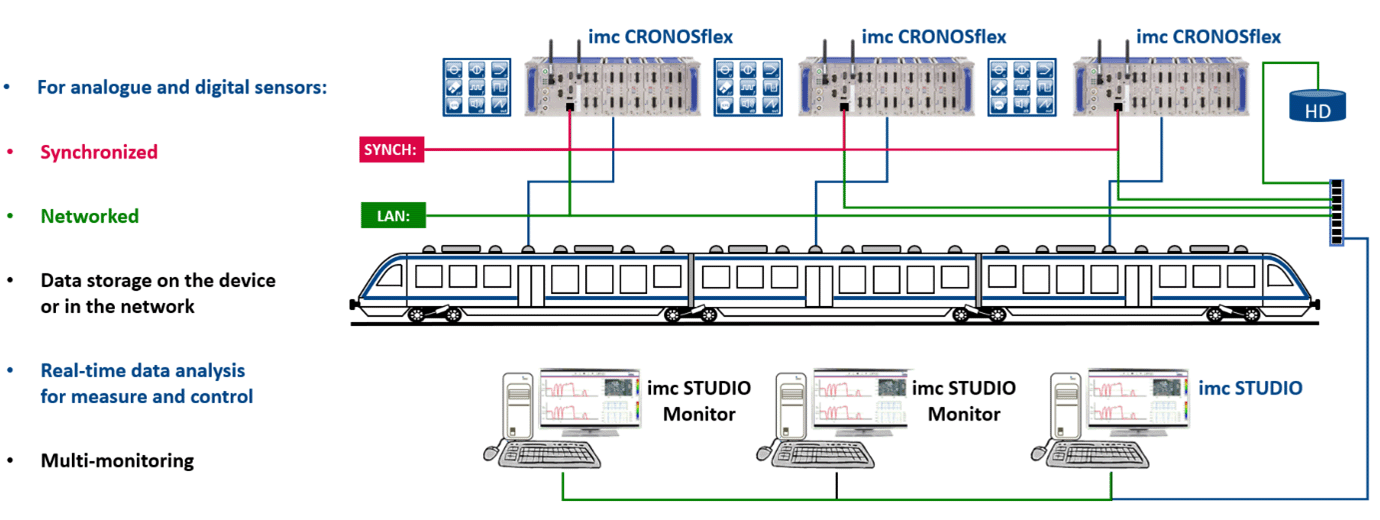
[Translate to Chinese (Simplified):] Distributed imc CRONOSflex and imc ARGUSfit systems are networked via high-speed, real-time buses:
imc CRONOSflex: based on EtherCAT, a deterministic fieldbus for high-precision synchronization and fast data exchange over large channel counts.
imc ARGUSfit: uses fiber-optic links—immune to interference and suitable for long distances.
All imc DAQ systems support multiple synchronization methods:
- Cable sync for compact setups
- GPS or IRIG-B for long-range applications
- PTP (Precision Time Protocol) over Ethernet for distributed networks
A proprietary imc process guarantees sample-accurate timing across more than 1,000 channels distributed over multiple cars.
[Translate to Chinese (Simplified):] Power and Data over a Single Cable
[Translate to Chinese (Simplified):] CRONOSflex modules support Power-over-Ethernet, carrying power, data, and sync on one line. For larger networks, separate power modules can be integrated wherever needed—keeping installation clean and scalable.
[Translate to Chinese (Simplified):] Built for the Rail Environment
[Translate to Chinese (Simplified):] imc systems are designed for real-world rail conditions: shock- and vibration-proof, with optional extended temperature range from –40 °C to +85 °C (–40 °F to +185 °F ) and high EMC immunity. The imc PROTECT series is built for the toughest test environments.
[Translate to Chinese (Simplified):] Modular Architecture for Every Task
[Translate to Chinese (Simplified):] With imc CRONOSflex and imc ARGUSfit, imc offers two fully modular and distributed DAQ systems that can be flexibly combined to cover any rail testing requirement. Both platforms follow the same principle: measurement modules are positioned close to the sensors, digitizing signals right at the source and transmitting them synchronously across the train:
- imc CRONOSflex: A high-precision, modular DAQ system for large channel counts and demanding test programs. Ideal for certification, validation, and multi-car measurements, it supports EtherCAT networking, Power-over-Ethernet, and long-distance scalability.
- imc ARGUSfit: An ultra-compact, click-modular DAQ system designed for confined installation spaces such as underframes or interiors. Its fiber-optic link ensures interference-free operation and high data rates over extended distances.
For specialized measurement tasks, these systems can be seamlessly expanded with complementary imc solutions:
- imc BUSDAQ: A fieldbus data logger (CAN, MVB, Ethernet, etc.) that synchronizes perfectly with all imc DAQ platforms.
- imc Telemetry: For wireless signal acquisition from rotating components such as wheelsets or brake discs, transmitting measurement data reliably to the imc DAQ system
Together, these modular systems provide engineers with a flexible, distributed measurement architecture—scalable from individual subsystems to complete trains.
[Translate to Chinese (Simplified):] Centralized Control and Real-Time Insight
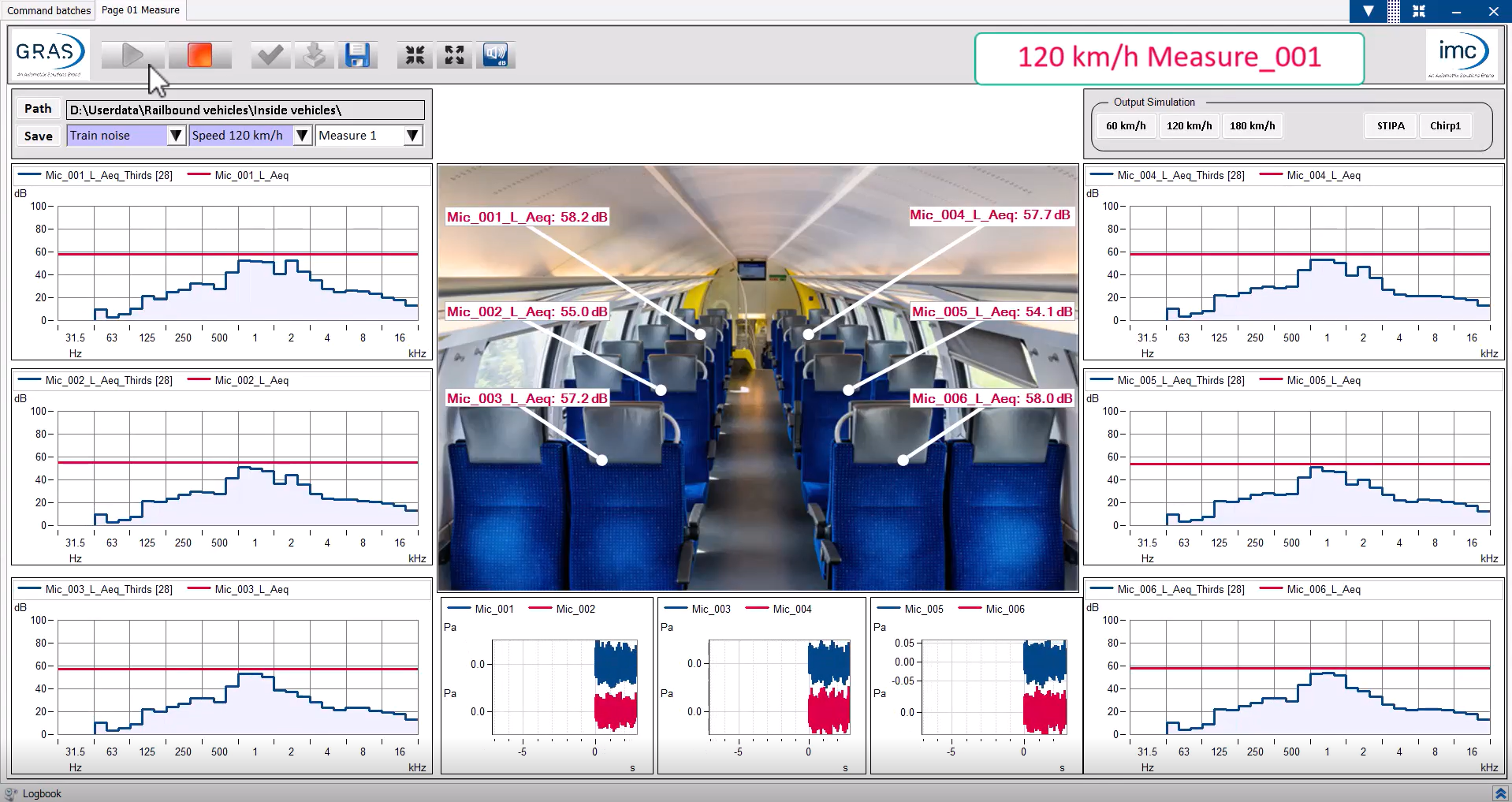
[Translate to Chinese (Simplified):] With imc STUDIO software, all distributed modules can be configured, controlled, and monitored from one interface—no matter where they sit in the train.
Engineers can:
- Visualize and monitor signals live
- Automate measurements and trigger on events
- Run first analyses during test runs
- Detect limit violations instantly
Seamless integration with imc FAMOS allows detailed post-processing, automated evaluation, and customized reporting.
From measurement to report—a continuous, efficient workflow for rail testing.
[Translate to Chinese (Simplified):] Fits Right into Your Development Workflow
[Translate to Chinese (Simplified):] imc DAQ systems integrate easily into existing toolchains:
- Import of sensor lists, thresholds, and metadata
- Export to MATLAB®, Python®, or DIAdem™
- Standard formats (MDF4, CSV, HDF5) for universal data access
- Direct links to databases and network storage
Proven in the Field
From Prototype to Series Approval
During train development, hundreds of sensors record strain, temperature, and acceleration across the vehicle.
Distributed imc CRONOSflex modules digitize these signals at the source and stream them synchronously to the base unit—providing real-time insight into entire subsystems.
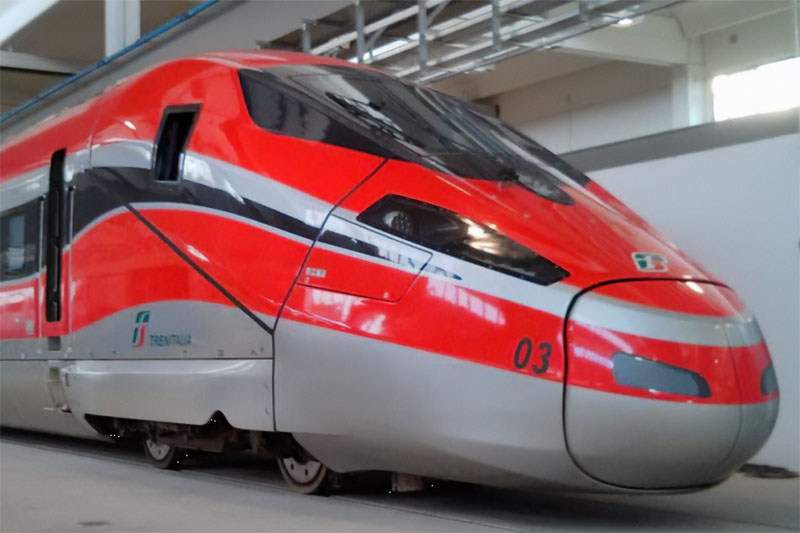
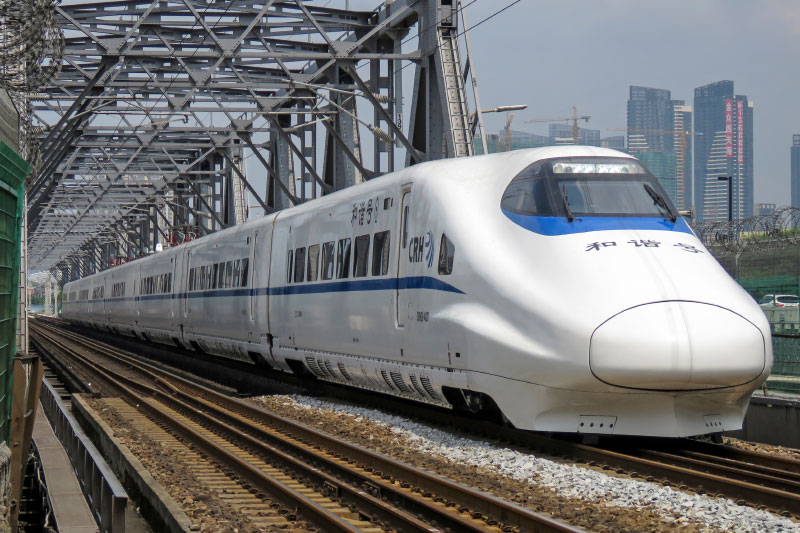
High-Speed Train Certification
For the certification of the Frecciarossa 1000, Italcertifer captured more than 300 channels across several cars using imc CRONOSflex and CRONOScompact.
Acceleration, force, temperature, and bus data were logged synchronously at up to 100 kS/s per channel and analyzed in real time.
Conclusion: Efficient, Rugged, Connected
imc distributed DAQ systems provide a solid foundation for safe, efficient, and standards-compliant testing of modern rail vehicles. From individual components to entire trainsets, the modular concept offers maximum flexibility with minimal installation effort.
Your Benefits:
- Up to 70 % less cabling
- Best-in-class signal quality through at-source digitization
- Microsecond-accurate sync across 1,000 + channels
Field-proven in hundreds of rail projects worldwide.
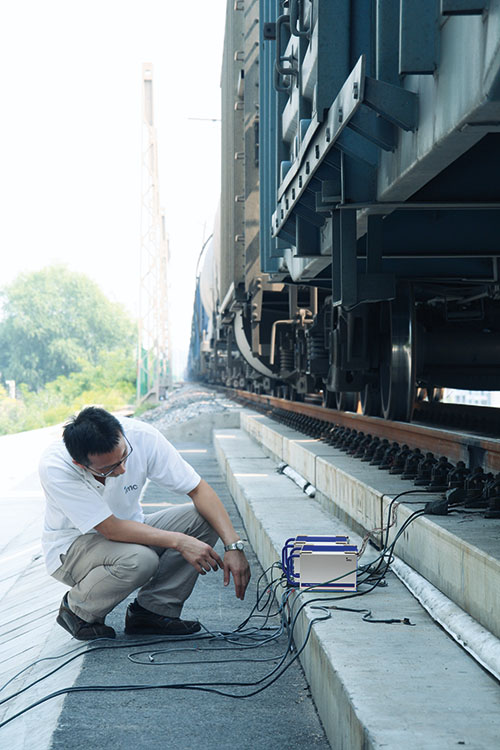
Your Next Rail Measurement Project – Let’s Talk
Which system best fits your application? Our application engineers understand the specific demands of rail testing and support you from concept through commissioning. Book a meeting with our experts:
Contact us
遨谱(上海)科技有限公司
免费热线电话:400-888-9826
北京办:丰台区航丰路1号院2号楼 时代财富天地A座 2511室, 100070
上海办:上海市闵行区申长路1398弄1号阿里中心T1座502室,201107
重庆办:渝北区赛迪路2号金山商业中心A座6楼, 410021
报价查询 : cnsales@imc-tm.com
订单查询 : cnorder@imc-tm.com
技术查询 : cnsupport@imc-tm.com


© imc Test & Measurement GmbH. All rights reserved. Privacy. Incident Reporting. Company Information.
 Top
Top